Ask how an accounting firm in Dubai gets clients and most partners will say the same thing: referral, reputation, the client who was happy enough to mention your name to a friend. That is still true. It is also no longer the whole answer and the gap in it is measurable today, not next year.
How do accounting firms get clients?
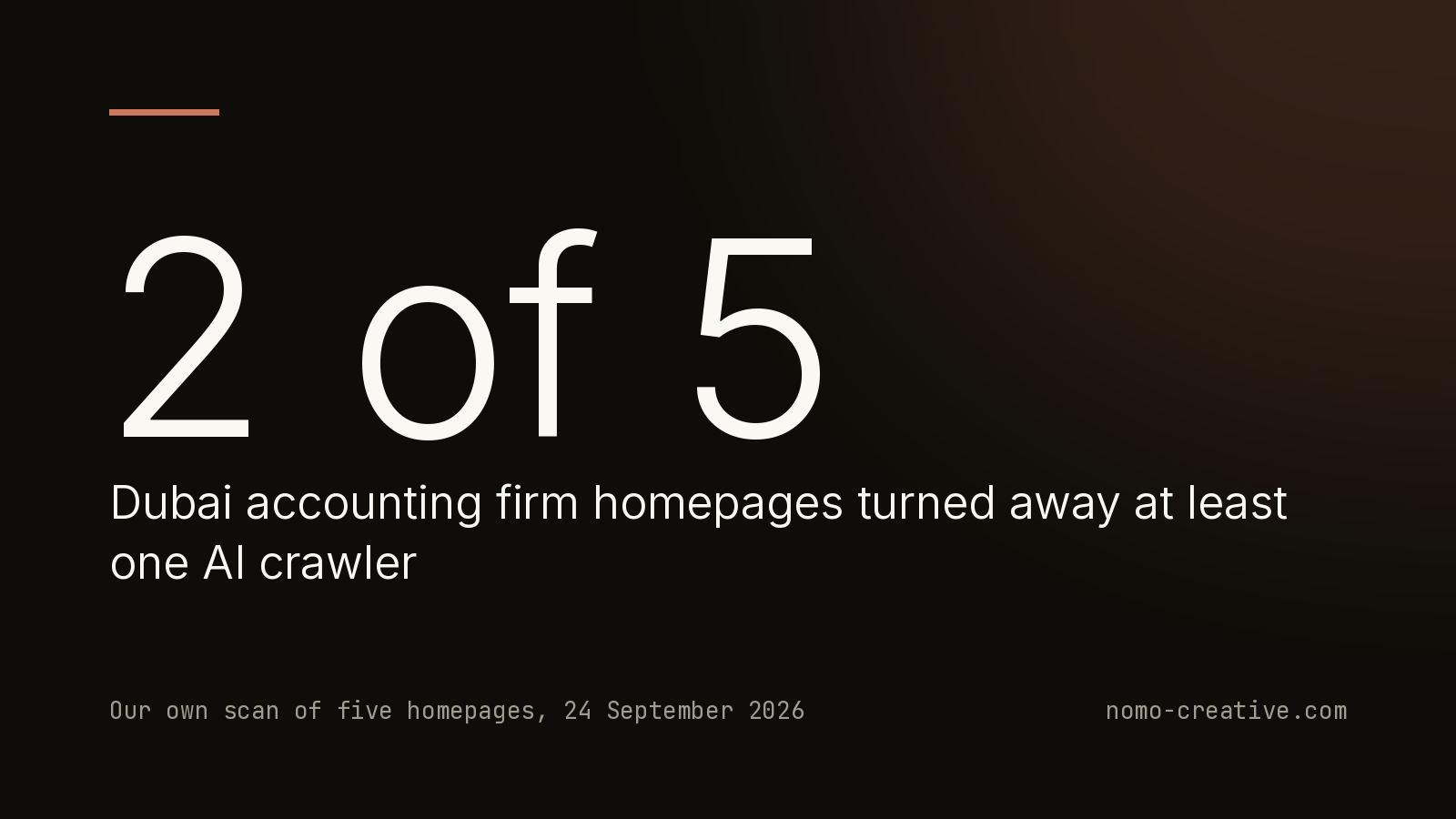
Mostly referral and reputation and a growing share of buyers now put a question to an assistant somewhere in that chain, before they call. On 24 September 2026 I scanned five Dubai accounting firm homepages the way a crawler sees them, JavaScript off and two were unreachable by at least one of the crawlers that assistant would use.
That is not a small technical footnote. It is the exact channel a referral now travels through on its way to becoming a call.
| What was measured | Result across five firms |
|---|---|
| Readable to GPTBot, JavaScript off | 3 of 5 |
| Blocked or throttled for at least one AI crawler | 2 of 5 |
| Genuine llms.txt file served | 2 of 5 |
| Headings phrased as the client’s own question | 0 of 5 |
| Homepage links out to Instagram and LinkedIn | 3 of 5 |
Firms are not named here. This is a category finding, not a report card on anyone in particular and naming a firm’s weak result in public marketing is not something we do.
Can an accounting firm block one AI crawler without knowing it?
Yes and this is the finding that surprised me most in this scan. On 24 September 2026, one Dubai auditor’s homepage answered ClaudeBot, PerplexityBot and a plain browser request normally. The identical request, made with GPTBot’s exact published user agent string, came back with an error both times it was tried.
Its robots.txt allowed every crawler, no exceptions listed. So the block was not a policy decision anyone made on purpose. It sat somewhere further down the stack, in a security or rate limiting layer nobody had reason to check against a user agent name, because nobody was looking for it.
A second firm went further still. Its homepage returned a security challenge page to GPTBot, to ClaudeBot and to a plain browser making the same non-interactive request, every single time. Robots.txt on that site also said everyone was welcome. What the server actually served said otherwise and no amount of reading robots.txt would have told the firm that.
Does a big LinkedIn following mean an accounting firm gets found?
Not by itself. Three of the five firms link out to LinkedIn from their own homepage, so I checked those pages directly on 24 September 2026, reading the follower count, the posting cadence and the reactions on the most recent handful of updates for each one, the same way a prospective client scrolling past would see them.
| LinkedIn following | Posting cadence | Reactions on a typical post |
|---|---|---|
| 19,191 | about once a week | 1 to 3 |
| 13,106 | several times a week | 7 to 14 |
| 12,618 | about once a week | 1 to 6 |
Between twelve and nineteen thousand people follow these pages. None of the three has stopped posting, which rules out the easy explanation. What they share instead is a following that scrolled past without stopping, on a platform whose own algorithm rewards exactly the reaction these posts are not getting. A page an algorithm stops showing to people is quietly the same problem as a page a crawler cannot read. Different layer, same result: nobody sees it.
Is SEO dead for accounting firms?
No, though the question itself is now a genuine search, not a rhetorical one and it deserves a straight answer instead of a dismissal. Ranking still routes a real share of traffic. What has changed is that ranking alone no longer guarantees a click, because a growing number of searchers read the summary above the results and stop there.
The clearest independent number on that comes from the Pew Research Center, published 22 July 2025, tracking 68,879 queries from 900 US adults in March 2025. With an AI summary present, users clicked a traditional result on 8% of visits, against 15% when no summary showed. Only 1% clicked a link inside the summary itself. Google disputes the methodology and that objection is worth stating rather than leaving out, since the sample is American and the data predates this year.
What that number does support, without needing the disputed parts: being ranked and being the one named in the summary are two different jobs now and a firm doing well at one can still be doing nothing at the other.
What would you check first?
Start with what a crawler actually receives, not what your robots.txt claims it allows. The gap between the two, on the auditor above, was the whole story. A firm can pass every policy check it wrote for itself and still be unreadable to the exact software reading it on a buyer’s behalf.
If you want to see what your own site and social pages actually show, the free AI check runs a version of this same scan and takes about ten seconds.
The honest caveat
A scan like this tells you what a crawler receives and what a LinkedIn page shows a stranger today. It does not tell you whether an assistant will name your firm when a client asks, because nobody outside those companies publishes how that selection works and anyone who claims to have cracked it is selling something.
What it does tell you is whether you have given either audience, the crawler or the follower, a reason to stop. Five Dubai accounting and audit firms here. Two closed a door they likely never noticed was there. Three kept a large room mostly quiet.
Both are fixable and neither needed a bigger following or a faster crawler to start.